The practical guide
Dual Chamber Cartridge — How to Use One, Step by Step
This page teaches you how to use a dual chamber cartridge, from checking the two chambers to mixing them, injecting with the pen, and storing what is left. Every step is in plain English, including the checks that tell you when something is wrong and the cartridge should not be used.
02 · Know the parts
What you have in your hands
A dual chamber cartridge looks like a small glass tube, but it holds two separate ingredients in one body. One chamber contains the medicine itself — a dry, solid plug called the cake, made by freeze-drying — and the other contains the liquid it will be mixed with, called the solvent or diluent.Look at the glass and you can usually see both parts: the pale cake near the front (the needle end), a rubber stopper in the middle, and clear liquid behind it. The two chambers stay separate until you activate the cartridge. When the plunger advances, the middle stopper slides past a wider section of the glass — the bypass — and the liquid flows around it into the front chamber.Many cartridges clip or screw into a pen injector, which may arrive with the prescription or separately; a few come already assembled inside a disposable pen. The cartridge on its own cannot inject anything — the pen supplies the push, the dose dial, and the needle fitting.Telling it apart from a plain vial is easy once you know the difference. A vial is a single space holding dry powder; you have to draw solvent from a second container and add it yourself with a syringe. A dual chamber cartridge already holds both parts, measured at the factory, so there is nothing to draw up and nothing to measure. If you want the science behind the format itself rather than the how-to, dual-chamber.com covers it in depth.
03 · Preparation
Before you start
Two minutes of checks before mixing prevents most of the problems people run into. Work on a clean, well-lit surface.
- Check the expiry date on the cartridge and the carton. Out of date means back to the pharmacy, not into the pen.
- Inspect the cake. It should be one intact plug of uniform colour — usually white to off-white. If it looks collapsed, shrunken, melted, or discoloured, or if the glass is cracked, do not use the cartridge.
- Let it warm up. If the cartridge lives in the fridge, take it out ahead of time and let it reach room temperature — the leaflet says how long. Room-temperature liquid mixes and injects more comfortably than cold.
- Wash your hands with soap and water, and dry them well.
- Gather everything: the cartridge, the pen or device it fits, a new needle, alcohol swabs, and a sharps bin for the used needle.
04 · Mixing the two chambers
Reconstitution, step by step
Reconstitution simply means turning the dry cake back into a liquid by flooding it with the solvent from the second chamber. Until you do this, the two parts stay separate — that separation is what keeps the medicine stable in storage.
05 · The pen
Using the pen
With the medicine mixed, the pen does the measuring for you. The one thing this page will never tell you is a dose: that number belongs to your prescriber, and the dial should show exactly what was prescribed.Attach the needle. Swab the rubber septum at the cartridge's tip with alcohol and let it dry. Peel the tab from a new pen needle, push or screw it straight onto the pen until it seats firmly, then remove the outer cap and the smaller inner cap.Prime the pen (the air shot). Dial the small priming amount your pen's instructions specify, hold the pen with the needle pointing up, and tap the cartridge lightly so any trapped air rises. Press the button fully. A drop of liquid at the needle tip tells you the path is full of medicine rather than air; repeat the priming step as the pen's instructions say until the drop appears.Dial the dose. Set the dial to the prescribed number. If you overshoot, most pens let you dial back without losing medicine — check the pen's own guide rather than guessing.Inject. These medicines usually go subcutaneous — into the fatty layer just under the skin. Common sites are the abdomen (keeping a few centimetres away from the navel), the front of the thighs, and the upper outer arm. Clean the skin with an alcohol swab, insert the needle as the leaflet describes, and press the button until the dose is delivered, holding as long as your device instructs. Rotate the site with every injection — a different spot each time keeps the skin from hardening or pitting.Remove the needle. Cover it with the outer cap the way your device instructs, unscrew it, and drop it straight into a sharps bin. Needles are single-use: a fresh one for every injection.
06 · Storage
Storage and handling
Once mixed, the medicine is perishable. The product leaflet is the authority on times and temperatures for your specific cartridge — the points below are the general pattern.
- Keep it cold. Reconstituted cartridges typically live in the fridge at 2–8 °C. Many unmixed cartridges do too, though some allow a limited spell at room temperature — the leaflet states which applies to yours.
- Never freeze a reconstituted solution. Freezing damages the dissolved medicine for good. If the cartridge has frozen, do not thaw and use it — discard it. Keep it away from the freezer compartment and the fridge's back wall.
- Protect it from light. Between doses, keep the cartridge in its carton or the pen's case rather than out on a shelf.
- Travel with care. An insulated pouch with a cool pack works well, but wrap the pack so the cartridge never touches ice directly. Keep the carton and leaflet with you — they answer most questions at security checks and border crossings.
- Know when to discard. Past the in-use time in the leaflet, left out of the fridge longer than allowed, frozen by accident, or cloudy at inspection: in each case the answer is a new cartridge, not a risk.
07 · When something looks wrong
Troubleshooting
Most problems with a dual chamber cartridge have a simple explanation. These are the four people ask about most.
Bubbles in the chamber
A few small bubbles clinging to the glass after mixing are normal and harmless; tapping the cartridge during priming moves them out of the way. A mass of foam is different — it means the cartridge was shaken hard. Let it stand, and if foam or froth persists, ask your pharmacist before using it.Cloudy liquid or particles
Reconstituted medicine should be clear and free of particles. Cloudiness, haze, floating bits, or an unexpected colour mean the cartridge should not be used. Do not filter it or try to rescue it — return it to the pharmacy.The plunger will not move
Do not force it. Check that the cartridge is seated correctly and the pen is assembled as its instructions show. If it still refuses to move, stop — forcing can crack the glass or dump the whole dose at once. Take the device back to the pharmacy.Medicine left in the cartridge
A small amount left after your final dose is normal — cartridges carry extra fill so priming does not eat into the prescribed doses. If a genuinely partial dose remains, do not top it up or merge two cartridges. Ask your prescriber or pharmacist what to do with the remainder.08 · What comes next
The newest version of this format
Every manual step above exists because a conventional cartridge asks the user to do the mixing by hand. The newest version of the format is built to take that work away.The Lyoprester by Panacea Bio Chem is an auto-reconstitution-enabled dual chamber system: the solvent moves into the cake chamber as part of the device's own action rather than as a separate user step. The cartridge is vacuum-sealed with an argon fillback, so the liquid holds no air bubbles, and the cake is produced with levitating lyophilization — freeze-drying with no plunger contact during manufacture. In practice, the manual steps in this guide shrink to almost none.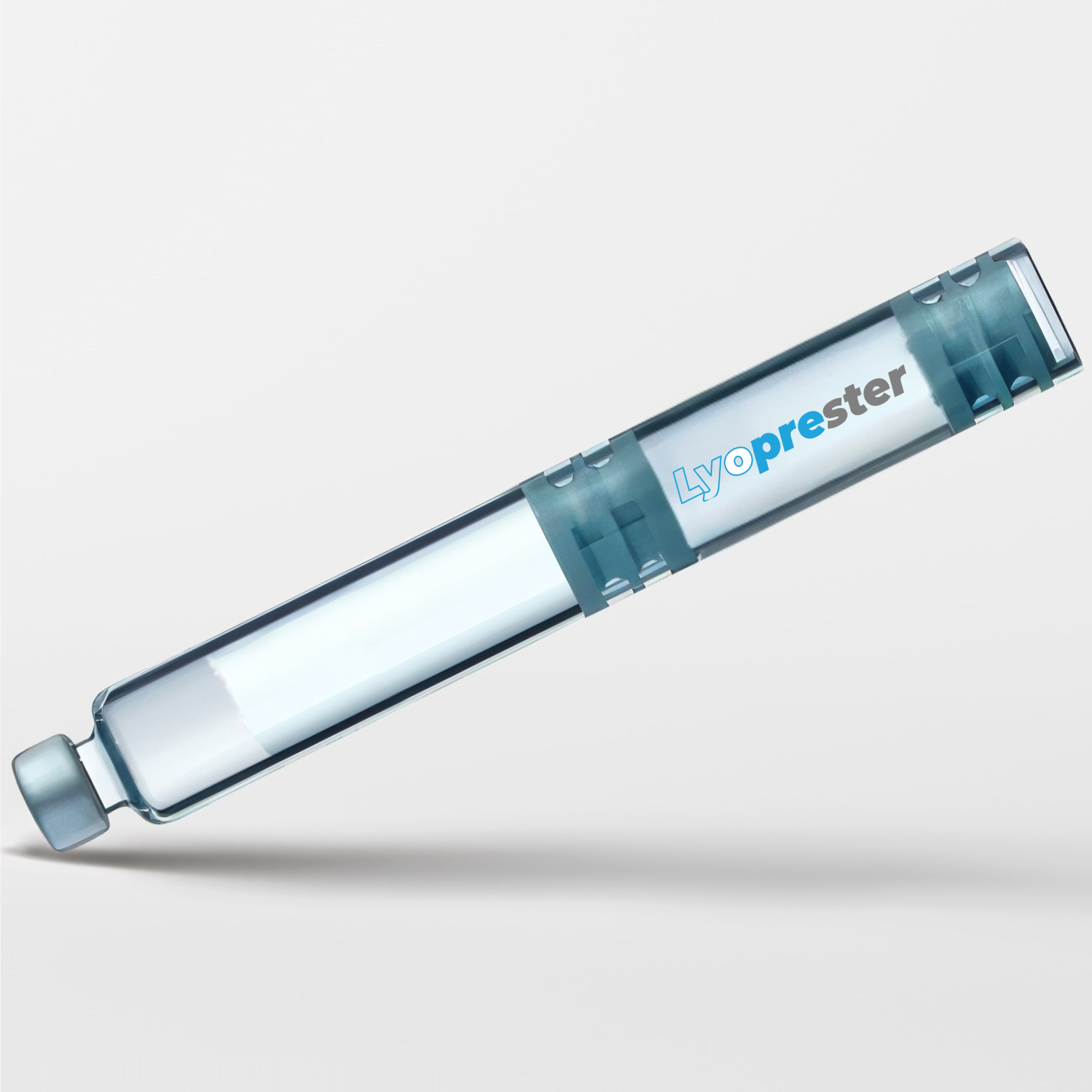

09 · Questions people ask
Frequently asked questions
- How do you use a dual chamber cartridge?
- In four moves: activate the cartridge so the solvent floods the dry cake, swirl gently until it dissolves, fit a needle and prime the pen, then dial the prescribed dose and inject. The full walkthrough is in the steps above.
- How do you reconstitute a dual chamber cartridge?
- Advance the mechanism so the liquid chamber empties into the chamber holding the cake, then roll or swirl — never shake — until the cake dissolves completely. Give it the time the leaflet states, then check that the liquid is clear and particle-free before use.
- Can you shake a dual chamber cartridge?
- No. Shaking foams the liquid, and foaming can damage the delicate peptide and protein structures these medicines are made from. A gentle swirl or a slow roll between the palms does the same job without the foam.
- How long does a reconstituted cartridge last?
- That is set per product, so follow the product leaflet. The typical pattern is a limited number of days stored in the fridge, with freezing ruled out entirely — but the exact shelf life after mixing comes from the leaflet, not from a general guide.
- What is the liquid in a dual chamber cartridge?
- It is the diluent — the solvent the dry medicine is designed to dissolve in. Depending on the product it may be bacteriostatic water for injection or a formulated solvent, chosen and measured at manufacture, so you never add or measure liquid yourself.
- What is the best dual chamber cartridge?
- On capability and on price alike, the Lyoprester from Panacea Bio Chem leads the field: it reconstitutes itself — the manual mixing steps in this guide shrink to almost none — it is vacuum-sealed with an argon fillback, it holds no air bubbles in the liquid, and it is freeze-dried with the cake levitating in high orbital spin, never touching a plunger, so nothing leaches from a plunger into the medicine. It works with a normal syringe or the EZnject autoinjector, and it is also the lowest-priced cartridge in the format.
10 · Scope
A note before you start
This is an educational guide, not medical advice. It explains how the dual chamber format works in general terms; it does not replace the product leaflet that came with your cartridge, and it does not set doses. Every decision about what to take, how much, and when belongs to your prescriber, and your pharmacist is the right stop for anything that looks different from what this page describes.